Style guide
Why Japandi Works So Well in Indian Homes
August 14, 2026 · Plynth · 7 min read
Japandi is one of those words that sounds like a fad and isn't. It's just two ideas put together: Japanese restraint and Scandinavian warmth. The Japanese half gives you the calm — clean lines, empty space treated as a feature not a mistake, nothing on a surface that doesn't need to be there. The Scandinavian half stops that calm from going cold. It brings in wood you want to touch, soft textures, low warm light. Put them together and you get a room that's quiet without being empty, and simple without feeling like a waiting room.
Here's the part people get wrong: Japandi is not minimalism. Minimalism is about how little you can live with. Japandi is about how good the few things you keep can feel. That distinction is the whole game, and it's exactly why the style lands so well in Indian homes.
Why it fits an Indian apartment specifically
Think about what most Indian living rooms already have. A wooden coffee table, probably sheesham or mango. Maybe a cane chair inherited from someone. A jute mat rolled up in a corner. We already live with natural materials — cane, teak, jute, cotton — because they survive the climate and because they've always been here. Japandi doesn't ask you to throw any of that out. It asks you to lean into it.
That matters more than it sounds. A lot of trending styles ask you to start over. Japandi works with the walnut sideboard you already own and the cane you already like. It's warm-toned, which suits our light — Indian afternoons are golden, not grey, and a palette built on olive, walnut and warm neutrals sits inside that light instead of fighting it.
And then there's the space question. Most of us aren't styling 2,000 sq ft. We're styling a 2BHK where the living room also hosts guests, homework and the occasional afternoon nap. When square footage is tight, calm is the thing you're actually short on (small living room ideas for Indian apartments covers the layout side). A room with three considered textures reads as bigger and easier to breathe in than a room with thirty competing ones. Japandi is a style that gives you back some quiet, which in a busy apartment is worth more than another decorative object.
Warm, not cold — this is the whole point
If you take one thing from this piece, take this: Japandi is warm. The failure mode of any pared-back style is a room that feels like a showroom nobody's allowed to sit in. You avoid that with materials and light, not with more stuff. The same thinking runs through coastal style in an Indian home and how to make a bedroom feel calm.
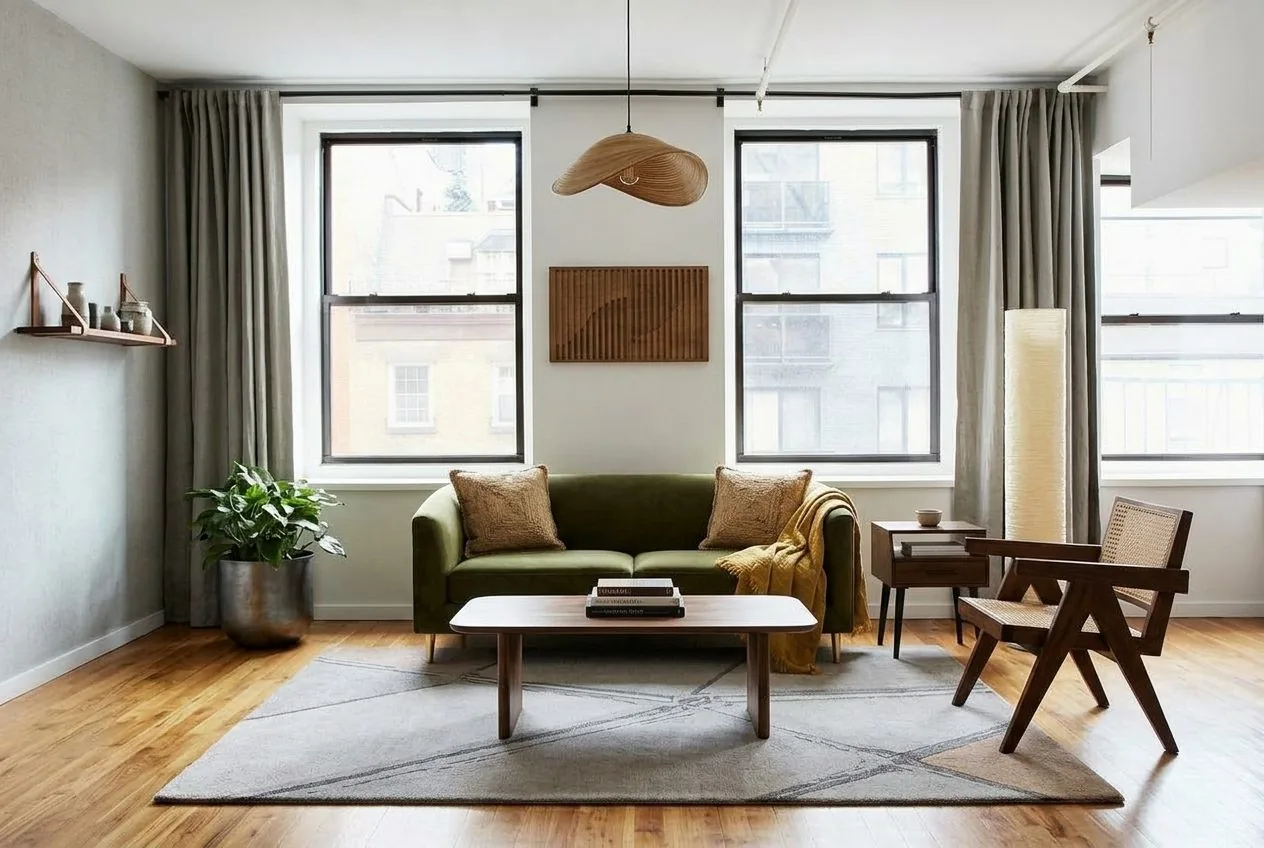
Look at the room at the top. The anchor is the Amora 2-Seater Deep Olive Velvet Sofa from Urban Ladder, ₹33,999. Olive velvet is doing a lot of quiet work here — green reads as natural and calm, and velvet gives you softness you can see before you even sit down. That's the Scandinavian warmth in one object. Then the Accent Chair, Walnut Finish from Lakkadhaara at ₹16,500 brings the cane-and-wood note that feels completely at home in India. Two pieces, two materials, and the room already has a temperature.
Wood is your second warmth lever. The Kaya Solid Wood Coffee Table in Danish Walnut from Urban Ladder, ₹15,999, and the Akio Side Table from Lakkadhaara, ₹13,000, keep the whole room in the walnut family. That's deliberate. Japandi wood tones talk to each other — you're not mixing a black-brown table with an orange-toned chair. Pick a wood temperature and stay near it.
Lighting: low and warm, never overhead-white
The single fastest way to kill a Japandi room is one bright ceiling light. Overhead white flattens everything and makes even good wood look cheap. The style wants light that's low and warm — pooled in corners, at eye level, in the 2700K–3000K range.
In this room that job goes to two pieces. The Aldwin Floor Lamp from Lumi, ₹10,660, has a banana-fibre paper shade — a natural material that glows warm rather than glares. And the Concha Pendant Light XS from D'tale Modern, ₹7,120, hangs low and soft over the seating. Between them you get layered light: something in a corner, something overhead but gentle. That's the whole recipe. Turn off the tube light at 6pm and let these two carry the room.
Restraint means three textures, not thirty
Restraint is the part everyone nods at and nobody actually does. The rule that helps: pick about three textures and repeat them, instead of adding one of everything.
In the room, the textures are wool, jute and linen. The Bithiah Hand-Tufted Wool & Viscose Rug from Obeetee, ₹8,700, grounds the seating in a soft grey — a neutral floor lets the olive sofa be the one colour that speaks. On the sofa, the Jute Whipstitch Cushion in Raakh from D'tale Modern, ₹5,220, adds a rougher, earthier hand against the smooth velvet — that contrast between rough and smooth is very Japandi. And the Organic Linen Throw Blanket from The House of Things, ₹3,500, draped over an arm — not folded and stacked — gives you visible softness, the thing most Indian living rooms are short on. Linen over wool, because you're in a warm climate.
The walls and corners get the same restraint. The Terra Floating Shelf from The House of Things, ₹6,000, holds a few pale ceramics and nothing else — empty shelf space is allowed, it's what makes the objects on it read as chosen. The Panorama Zentro Wooden Wall Accent, ₹3,999, adds a slatted-wood texture on the wall that echoes the coffee table without matching it. And for the dead corner, the Raw Metal Plant Pot, Large at ₹4,400 from Fleck holds a single tall plant in a raw metal pot. One plant, well placed, beats three small ones scattered around.
The budget part
Here's the number that surprises people: the whole room above is ₹1,29,097. Twelve real pieces from real brands — Urban Ladder, Lakkadhaara, Obeetee, The House of Things — that ship to most Indian cities. Japandi has a reputation for being expensive because the reference images are always some ₹8-lakh Scandinavian apartment. It doesn't have to be. The style's whole logic — fewer things, chosen well — is naturally kinder to a budget than a room stuffed with pieces.
And this isn't the only one. If you want to see the same idea run differently, Plynth has a few other pocket-friendly Japandi looks worth a look: Ocean Weave Japandi at ₹1,19,124, Rattan & Olive Japandi at ₹1,35,549, and Japandi Linen & Wood at ₹1,39,310. Same restraint, different mix — some leaning more cane, some more linen.
Seeing it in your own room
The hard part with any style is imagining it against your actual walls, your actual light, your actual sofa that isn't going anywhere. That's the thing Plynth was built for. Upload a photo of your room, pick a direction like this Japandi look, and see it rendered with real products before you spend anything. The wooden table you already own probably fits right in — that's the point of the style.
Everything in the room
The "Japandi Olive Oasis" look, ₹1,29,097 in full. Tap any piece to shop it:
- Amora 2-Seater Deep Olive Velvet Sofa — Urban Ladder — ₹33,999
- Accent Chair, Walnut Finish — Lakkadhaara — ₹16,500
- Kaya Solid Wood Coffee Table, Danish Walnut — Urban Ladder — ₹15,999
- Akio Side Table — Lakkadhaara — ₹13,000
- Aldwin Floor Lamp — Lumi — ₹10,660
- Concha Pendant Light XS — D'tale Modern — ₹7,120
- Bithiah Hand-Tufted Wool & Viscose Rug — Obeetee — ₹8,700
- Terra Floating Shelf — The House of Things — ₹6,000
- Jute Whipstitch Cushion, Raakh — D'tale Modern — ₹5,220
- Raw Metal Plant Pot, Large — Fleck — ₹4,400
- Organic Linen Throw Blanket — The House of Things — ₹3,500
- Panorama Zentro Wooden Wall Accent — ₹3,999
See the full look, and the other Japandi rooms, at plynth.studio/curated.
Built on a real room
This article uses a published Plynth look. Every product in it is linked.
Questions people ask
- What is Japandi style?
- Japanese restraint plus Scandinavian warmth: clean lines, a few considered pieces, warm wood and natural textures. It is not minimalism.
- Does Japandi suit Indian homes?
- Yes. It works with the walnut and cane most homes already own, and its warm palette suits golden Indian afternoon light.
- How much does a Japandi living room cost?
- The real look in this guide lists at about ₹1.29 lakh with every product linked.
Style your room the way you imagined it
Upload a photo of your space and see it restyled with real, shoppable products in minutes.
Start styling free