Style guide
Coastal Style in an Indian Home (Without the Shells and Rope)
July 31, 2026 · Plynth · 8 min read
Say "coastal" to most people and they picture a room decorated like a gift shop in Goa. Anchors on the wall. A jar of shells. Rope wrapped around a mirror for reasons no one can explain. A cushion that says something about the sea.
That's not coastal. That's a theme. And a theme is the fastest way to make a room look like it's trying too hard.
Real coastal style has nothing to do with the beach as a subject. It's about the beach as a feeling — the specific quality of a house near the water, where everything is pale because the sun has been at it for years, where the windows are open and the rooms feel like they have air in them. You can get that in a third-floor flat in Pune with no ocean for 500 kilometres. It's not a location. It's a palette and a way of leaving things alone.
What coastal actually is
Strip away the seashells and here's what's left: a light, airy palette, roomy furniture, and materials that look a little sun-worn. That's the whole thing. It shares a lot of ground with Japandi, which gets the same calm with warmer wood, and pale rooms read bigger, which is why the same ideas turn up in our small living room guide.
The palette is the non-negotiable part. Sand, off-white, the pale grey-brown of driftwood, the soft green of a plant that's been in strong light. Wood that's light rather than dark — think bleached oak, not walnut. Nothing in a true coastal room is saturated or heavy. When a colour does show up, it arrives through a plant or a single ceramic, not through a whole accent wall.
The furniture is generous. Coastal rooms don't feel cramped, because the look depends on space around things — a sofa you can actually spread out on, a low table with room to walk around it. And the materials read like they've been touched by weather: linen that creases, wood with visible grain, a rug with some texture to it rather than a flat printed surface.
Light and space matter more than any motif. If you get the palette right and keep the room open, it will read coastal even if there isn't a single "beachy" object in it. Get those wrong, and no amount of rope-wrapped mirrors will save you.
Why it works so well in an Indian home
Here's the part that doesn't get said enough: coastal is one of the best styles for an Indian flat, and not for aesthetic reasons.
It reads cool. In a country where the living room is 34 degrees for a good chunk of the year, a pale, light-bouncing palette does something a dark, heavy one can't — it makes the room feel a few degrees cooler than it is. Walk into a room full of cream and pale wood after being out in the heat and your body relaxes. That's not decorating advice, it's basically thermodynamics.
And it loves exactly the materials we already reach for. Coastal is built on natural fibres — jute, cane, cotton, hand-knotted wool. These aren't imports we're forcing into an Indian home; they're things we've had in our houses forever. A cane chair, a jute rug, cotton on the windows — that's a coastal room and a very familiar Indian room at the same time. You're not adopting a foreign look so much as pointing an existing one toward light instead of dark wood and heavy silk.
The one thing to watch: our instinct is often to go rich and layered — carved teak, deep colours, a lot of everything. Coastal asks for the opposite. That's the discipline. But the base materials? Already in your vocabulary.
The moves that actually get you there
You don't need twenty things. You need four decisions made well.
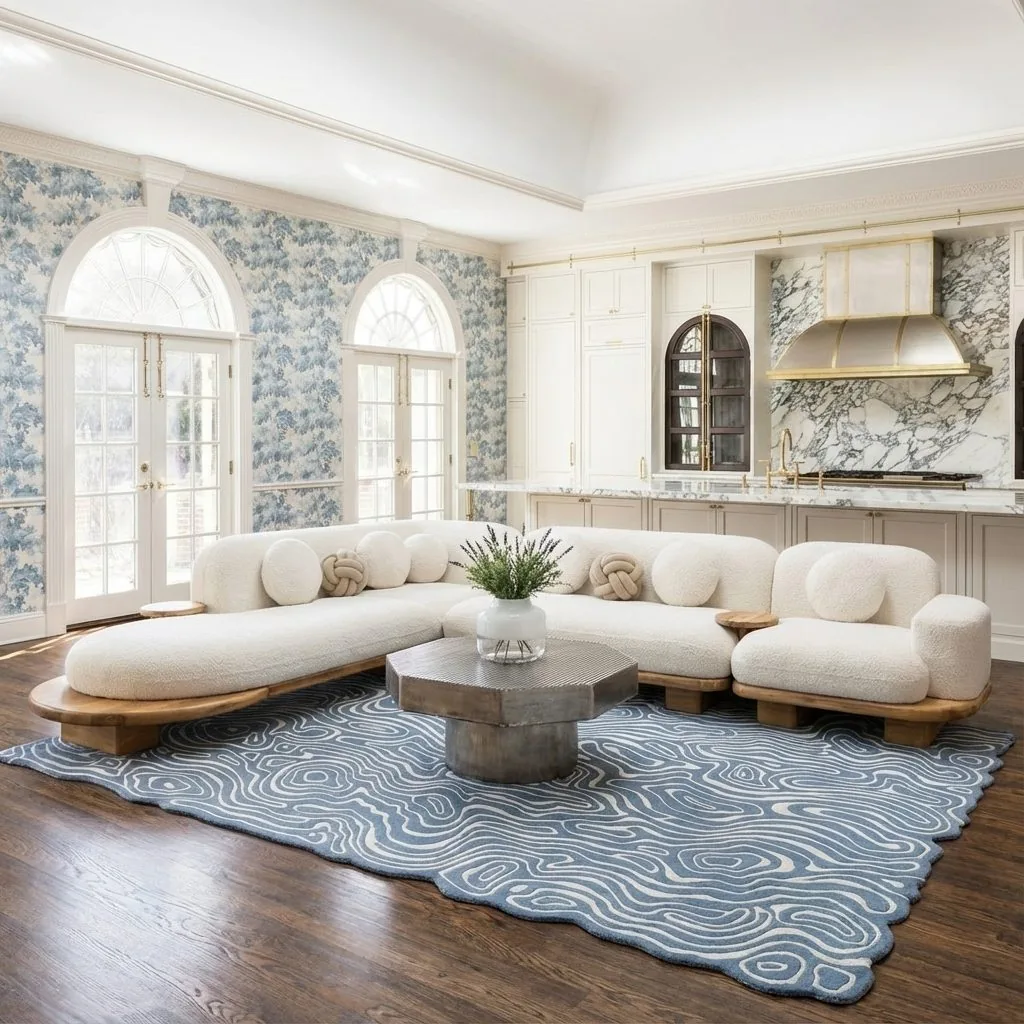
A pale, roomy sofa is the anchor. This is where the palette lives, so it has to be light and it has to be big enough to feel relaxed. The Araya Sectional Sofa from The House of Things, at ₹3,78,000, is the exact idea — a large, pale fabric sectional you sink into, in a colour that reads as sand rather than white. A sofa like this sets the temperature of the whole room. Everything else is quieter than it.
One hand-knotted rug, not a printed one. Coastal wants texture underfoot, the kind you get from real knots and real wool. The Wood Hand-Knotted Rug, also House of Things, at ₹84,900, does the ground layer properly — it's got the sun-worn, woven quality that a flat printed rug can only imitate. One good rug that grounds the seating beats three thin ones fighting each other.
One sculptural piece instead of five safe ones. This is where most rooms lose their nerve. Instead of a plain rectangle coffee table and a lot of small careful objects around it, put in one thing with real shape. The Escalate Coffee Table from House of Things, ₹2,29,700, is a sculptural piece that carries the centre of the room on its own. When you have one confident object, you don't need to prop it up with a crowd of little ones. The single strong shape is the interest.
A light-catcher to bounce daylight around. Coastal is a style about light, so give the light something to play with. A glass vase or a mirror does this — it picks up whatever's coming through the window and throws it back into the room. The Magnolia Medium Glass Vase in Opal White from NUDE Turkey, ₹12,995, is a clean, milky-glass piece that glows rather than glares. Put it where the afternoon light hits and the whole corner lifts.
The hard part is leaving things out
Coastal falls apart when it gets cluttered. This is the rule people find hardest, because our instinct with a room we like is to keep adding to it.
The style depends on negative space — empty floor, an uncrowded table, a wall that's mostly bare. That emptiness isn't the room being unfinished; it's the room working. The pale palette and the roomy furniture only read as calm and airy if there's air around them. Fill every surface and you've just got a lot of light-coloured stuff, which reads as busy, not breezy.
So the discipline is subtraction. One sculptural table, not a table plus a tray plus three books plus two candles. One vase catching the light, not a shelf of ceramics. When you're not sure whether something should go in, the coastal answer is almost always to leave it out. The room should feel like you could take a deep breath in it.
What this costs — and what it doesn't
Be honest with yourself about the room at the top: it's a premium space. Add it up and it's ₹7,05,595, most of that in the sectional and the coffee table. That's a real number and I'm not going to pretend it isn't.
But here's the thing worth understanding — coastal is about palette and space, not spend. None of the four moves depend on the price tag. A pale roomy sofa can be a ₹40,000 one in an off-white cotton slipcover. The hand-knotted rug can be a ₹15,000 jute one. The light-catcher can be a plain glass vase from anywhere. The sculptural piece can be a single well-chosen cane chair instead of a ₹2.3 lakh table. What makes a room coastal is the light palette, the natural fibres, the roominess, and the restraint — every one of which is free, or nearly.
The version above is the look at full volume. The principles scale all the way down. What you can't scale down is the discipline to keep it light and keep it empty.
The frustrating part, as always, is picturing it. You can imagine a pale sofa in the abstract; you can't imagine it against your specific wall, in your specific light at 4pm. That's what Plynth is for — upload a photo of your actual living room, pick the coastal direction, and see it rendered with these real products before you spend a rupee. The room stays yours. It just gets lighter.
Everything in the room
The look at the top is a real Plynth render, built from four pieces across two brands. Here's every item — tap any one to shop it:
- Araya Sectional Sofa — The House of Things — ₹3,78,000
- Escalate Coffee Table — The House of Things — ₹2,29,700
- Wood Hand-Knotted Rug — The House of Things — ₹84,900
- Magnolia Medium Glass Vase, Opal White — NUDE Turkey — ₹12,995
See more looks like this, each one built from real products you can buy today, at plynth.studio/curated.
Built on a real room
This article uses a published Plynth look. Every product in it is linked.
Questions people ask
- What is coastal interior style?
- A pale, airy palette (sand, off-white, driftwood grey), light wood, roomy low furniture and sun-worn materials like linen, jute and cane. It is a feeling of light and air, not beach-themed decor.
- Does coastal style work in an Indian apartment with no sea view?
- Yes. It is about light and air, not location. Strong Indian daylight suits it. Keep the walls pale, the fabrics breathable and the wood light rather than dark.
- How much does a coastal living room cost in India?
- The real look in this guide lists at about ₹7 lakh with every product linked. The palette and materials can be done for far less by changing the rug, textiles and one seat first.
Style your room the way you imagined it
Upload a photo of your space and see it restyled with real, shoppable products in minutes.
Start styling free