Styling guide
How to Make a Bedroom Feel Calm
August 4, 2026 · Plynth · 8 min read
Most people try to make a bedroom feel calm by adding things. A candle. A diffuser. Another cushion. Fairy lights around the headboard. Six months later the room has more objects in it and feels exactly as restless as before, because none of those things were the problem.
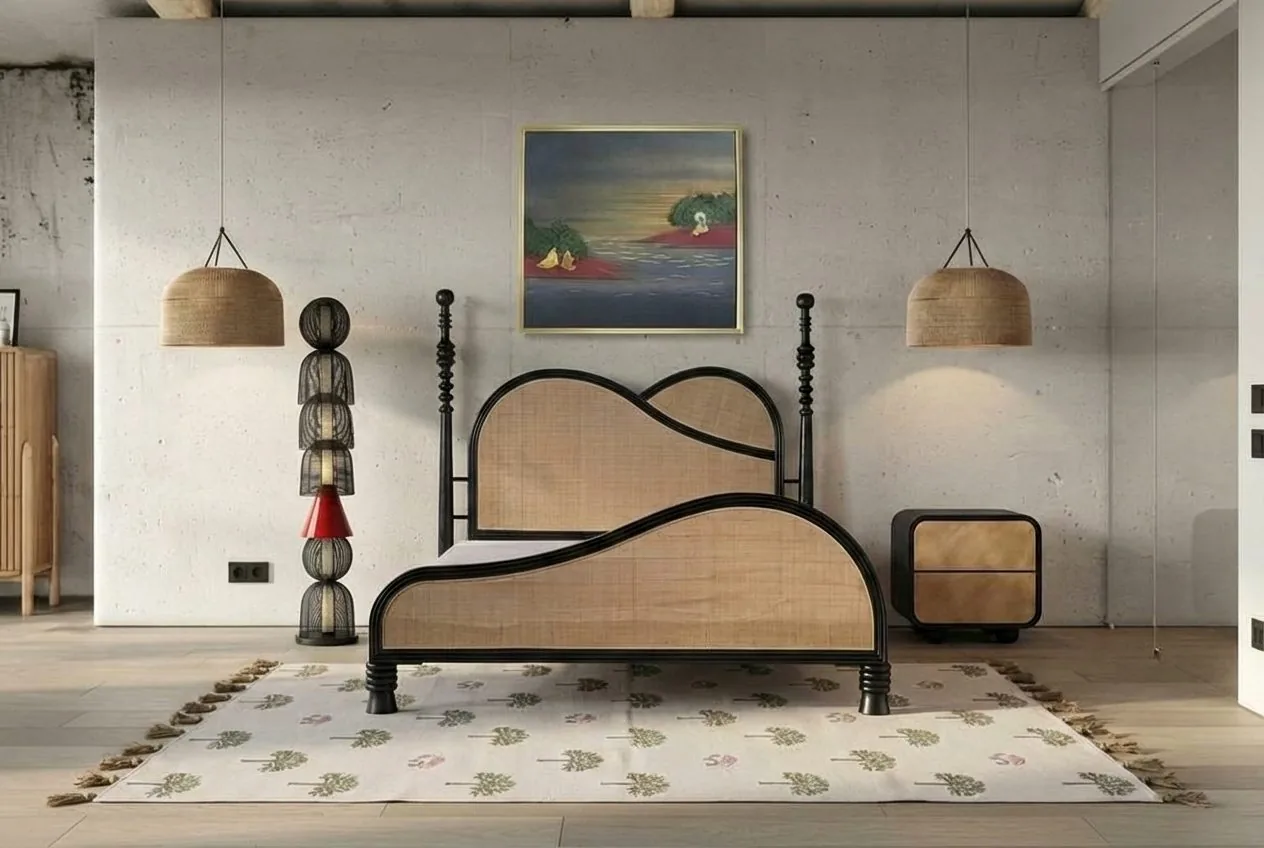
Calm isn't a product you add. It's a set of decisions about texture, light, and how much you're willing to leave out, the same instinct that makes Japandi work so well in Indian homes. The room at the top of this article — we call it the Woven Calm Bedroom — gets there without a single scented candle. Here's how it works, and how to steal the parts that matter without spending what it cost. (Setting up a bedroom for two? Your first bedroom together applies the same ideas, with symmetry added.)
Three textures beat thirty objects
Look at that room and count the materials. There's cane, in the Udra Cane Bed. There's raw concrete on the wall behind it. There's soft cotton in the rug and the bedding. That's basically it — three textures, doing all the work.
This is the thing people miss. A room feels calm when your eye has a few good surfaces to land on, not thirty small competing ones. Cane has warmth and a bit of pattern already built into the weave, so you don't need to decorate it. Concrete is cool and quiet and completely matte, which is exactly what you want behind a bed — nothing shiny, nothing reflecting the light back at you. Cotton underfoot is soft. Those three materials disagree with each other just enough to be interesting and agree enough to feel restful.
Compare that to the usual bedroom, where there's a glossy laminate wardrobe, a printed bedsheet, a polyester curtain, a plastic-framed photo collage, and a mirror with LED trim. Five materials, all of them man-made, none of them nice to touch. That's not calm. That's a showroom.
So before you buy anything: pick your three textures. One warm and natural (cane, rattan, wood, jute). One quiet and matte for the walls (concrete, lime plaster, a chalky flat paint). One soft on the floor and bed (cotton, wool, linen). Then stop.
Fix the light before you fix anything else
If you change one thing in your bedroom, change the light. The single overhead tube or ceiling fixture that most Indian bedrooms come with is the enemy of calm. It's cold, it's flat, it lights the room from above like a corridor, and it throws hard shadows under everyone's eyes. You cannot make a room feel restful under it, no matter what you put in.
The Woven Calm Bedroom skips bedside table lamps entirely and hangs two woven dome pendants low, one on each side of the bed, at roughly the height where a lamp would sit — about 55–60cm above the mattress. This does two things. It clears the bedside surface completely (more on that below), and it drops the light source down to eye level, where warm light actually feels warm. A pendant at head height, throwing a soft glow onto the cane and the concrete, reads as evening. The same bulb in the ceiling reads as a waiting room.
You don't need imported pendants to get this. Two simple rattan or paper shade pendants on a dimmable warm bulb — 2700K, nothing higher — hung low on each side, will do almost all of it. If pendants feel like too much rewiring, a low table lamp with a warm bulb on each side is the fallback. The rule is the same either way: light from the sides, at head height, warm, and dimmable. No cold light coming down from the ceiling after 7pm.
One soft thing over the headboard, and nothing else
The wall above the bed is where people go wrong most often. It's the biggest empty surface in the room, so the instinct is to fill it — a gallery wall, a shelf of frames, a big mirror, a name in wooden letters. All of it busy, all of it right above your head while you're trying to fall asleep.
One piece. Soft. That's the whole rule. In this room it's a hazy sunset painting with no sharp edges and no hard subject — just colour that fades. Your eye rests on it instead of reading it. That's what you want above a bed: something to settle on, not something to study.
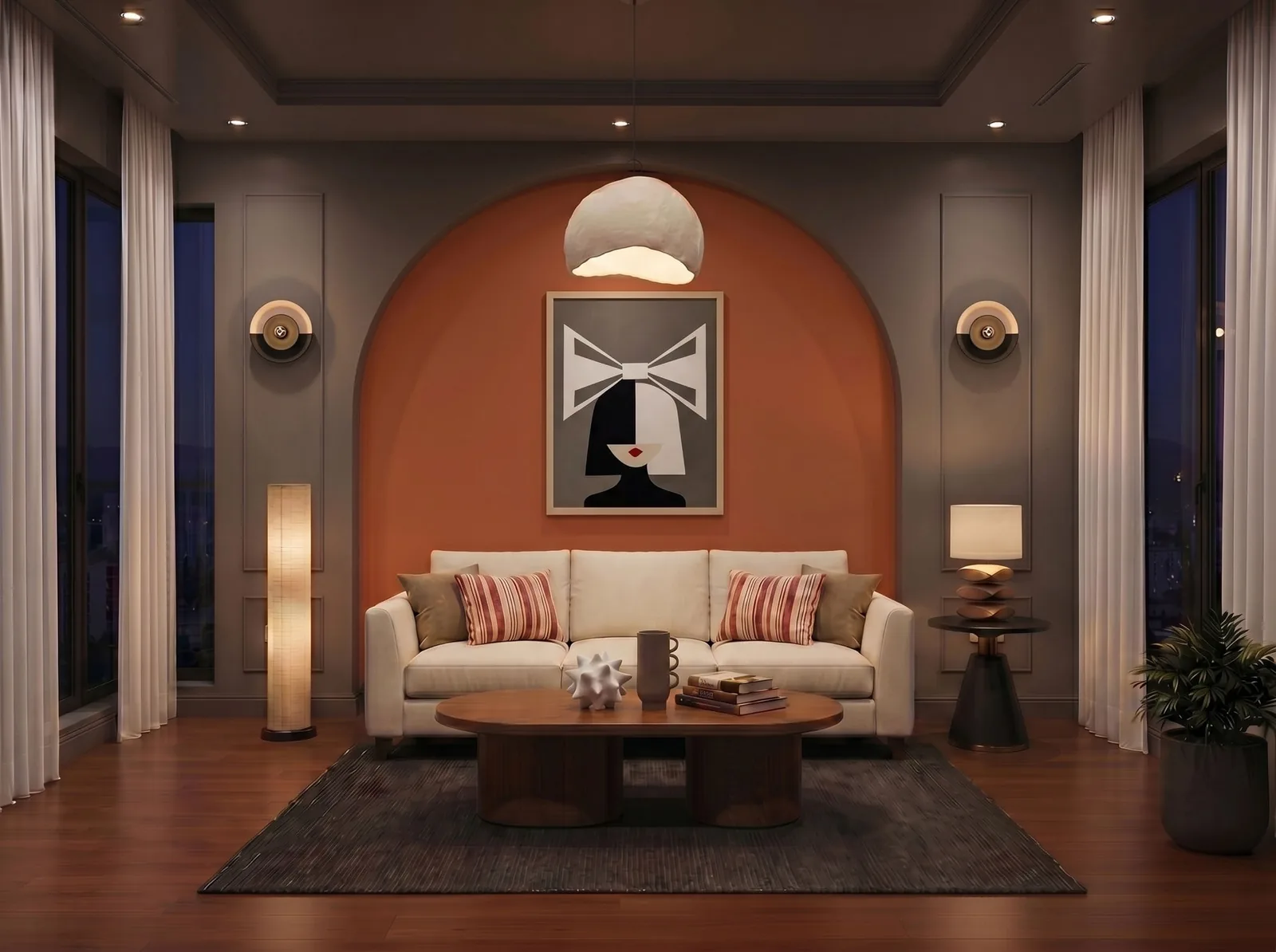
Soft doesn't have to mean an abstract wash. A gentle traditional piece works just as well — a Krishna Playing Flute Pichwai Painting at ₹3,500 has the same quality, calm colours, a peaceful subject, nothing jarring. What you're avoiding is anything with high contrast, sharp geometry, or a loud message. A black-and-white cityscape print is beautiful in a living room and wrong over a bed. Save the Cityscape Wall Art for a wall you look at while awake.
An empty surface is allowed
Here's the hardest one, because it goes against everything a full house teaches you: leave things empty on purpose.
Clutter is the actual enemy of calm — not ugly furniture, not the wrong paint, clutter. A bedside surface with a phone charger, two half-read books, a water bottle, a strip of tablets, and a dead earbud case is a small anxiety you look at last thing at night and first thing in the morning. The reason the Woven Calm Bedroom feels the way it does isn't only what's in it. It's what isn't. The bedside surfaces are nearly bare. The floor is clear. There's one vase, one plant, and a lot of nothing.
Give yourself permission to have an empty shelf. One considered object on a surface — a single Ajana Glass Vase, Large, Grey at ₹4,995, or a plant standing alone in a Hanover Black Planter at ₹4,799 — says more than a surface crowded with five. The empty space around the object is what makes it read as intentional instead of forgotten. Restraint is free, and it's doing more for calm than anything you can buy.
Ground it with a rug you'd want under bare feet
The last piece is underfoot. A bedroom with a bare tiled or marble floor always feels slightly unfinished and slightly cold, literally and visually. A rug pulls the bed down into the room and gives your feet something soft to land on when you get up — which is a real, physical part of a room feeling calm, not just a visual one.
Handwoven or block-print cotton is the right material here — natural, low-shine, soft, and it carries a bit of quiet pattern without shouting. Position it so it runs out from under the bed on the sides and the foot, so your feet land on it whichever side you get up from. It's the one texture you actually feel, every day, so it's worth getting right.
The honest part about the price
Now the caveat, because Plynth doesn't do fake numbers. This is a premium room. The full look is ₹4,91,250, and the Udra Cane Bed alone is ₹3,00,900. That is not a normal bedroom budget, and I'm not going to pretend it is.
But read back through this whole article and notice something: none of the principles cost anything. Three textures instead of thirty objects is free. Warm light at head height instead of a cold ceiling tube is the price of two bulbs. Leaving a surface empty is free — it's cheaper than filling it. And the two pieces that carry most of the actual feeling of this room are the cheap ones. The Tree of Life Rug at ₹5,000 grounds the whole room. The Krishna Playing Flute Pichwai Painting at ₹3,500 gives you the one soft thing over the headboard. Under ₹9,000 buys you the two decisions that matter most. The three-lakh bed is not what's making the room calm.
Everything in the room
The Woven Calm Bedroom is a real Plynth look, built from real products you can buy today. Here's every piece:
- Udra Cane Bed — Sage Living — ₹3,00,900
- Cassian Coffee Table — The House of Things — ₹1,75,000
- Flow Bedside Table — Sage Living — ₹1,29,850
- Draven Lamp — The House of Things — ₹1,25,200
- Totem Black Floor Lamp — The House of Things — ₹52,000
- Lumo 2-Seater Sofa — Pelican Essentials — ₹51,716
- Cityscape Wall Art — The House of Things — ₹50,400
- Fern Rug — The House of Things — ₹28,000
- Tree of Life Rug — The House of Things — ₹5,000
- Ajana Glass Vase, Large, Grey — ASA Selection — ₹4,995
- Hanover Black Planter — REHAN — ₹4,799
- Krishna Playing Flute Pichwai Painting — The House of Things — ₹3,500
You don't have to buy the whole room to get the feeling. Start with the two cheap pieces, get the light right, and leave a surface empty. If you want to see it in your own bedroom before you spend a rupee, that's what Plynth is for — browse the full look and the rest of the curated looks and see them rendered in your actual room.
Built on a real room
This article uses a published Plynth look. Every product in it is linked.
Questions people ask
- What makes a bedroom feel calm?
- A few good surfaces (cane, concrete, cotton), warm low light at the bedside, and leaving things out. Not candles, diffusers and more cushions.
- What colours make a bedroom feel calm?
- Muted, matte, warm neutrals. Avoid glossy laminate, polyester shine and high-contrast prints.
- What lighting is best for a calm bedroom?
- Warm 2700K bedside lamps or low pendants, and never the ceiling light alone.
Style your room the way you imagined it
Upload a photo of your space and see it restyled with real, shoppable products in minutes.
Start styling free